
- – Lanem Law Kuma reflects on Dr Amani Abou-Zeid’s contributions to Africa’s Tech Advancement
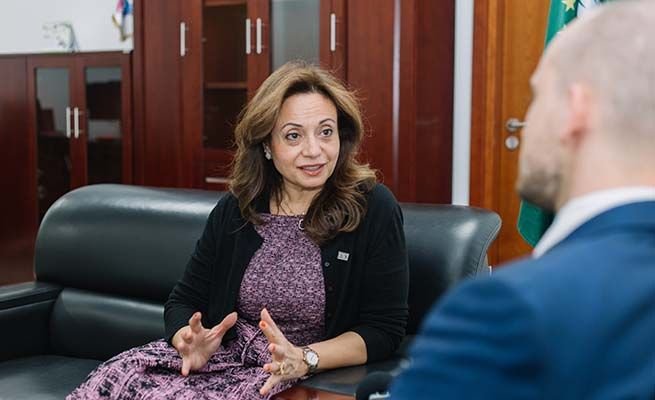
Across conference rooms from Paris to Addis Ababa, H.E. Dr. Amani Abou-Zeid, the African Union Commissioner for Infrastructure and Energy since 2017, emphasizes that Africa will not only participate in the Fourth Industrial Revolution but will also lead it. Combining her engineering background with policy expertise, she is actively removing obstacles to Africa’s digital progress and promoting an approach that is both cutting-edge and distinctly African. With over thirty years of experience at prominent organizations like the African Development Bank, UNDP, and USAID, Dr. Abou-Zeid offers extensive knowledge in key sectors vital to Africa’s future: Energy, Transport, Tourism, and ICT.
Her diverse educational background—comprising electrical engineering, public administration from Harvard University, and a Ph.D. in Social and Economic Development—gives her a rare ability to connect technical complexity with socioeconomic impact. This unique blend positions her well to support initiatives that go beyond simply importing technology, focusing instead on fostering Africa’s own innovation ecosystems. As a result, the continent is being shaped not just as a technology consumer but as a budding leader in the global digital economy.
The Digital Transformation Strategy (DTS) 2020-2030
Under Dr. Abou-Zeid’s guidance, the African Union introduced the innovative Digital Transformation Strategy (DTS) for Africa 2020-2030. This detailed plan aims to unify technology efforts across the continent’s economy, education, and agriculture sectors. The goal is to establish a single digital market by 2030, encouraging innovation across borders and enabling technological solutions to be expanded continent-wide. The DTS reflects Africa’s strong commitment to leveraging the fourth industrial revolution for inclusive growth and job creation, emphasizing that digital infrastructure is as essential as traditional physical infrastructure for development.
Revolutionizing Internet Connectivity
Under Dr. Abou-Zeid’s leadership, a key achievement has been the significant growth of the African Internet Exchange System (AXIS). This expansion has raised the number of AU Member States with Internet Exchange Points (IXPs) from 18 to 35. Such infrastructure progress ensures more African internet traffic stays within the continent instead of traveling through international hubs, leading to faster speeds and lower costs for users and businesses. By keeping local traffic local, AXIS enhances user experience, boosts digital sovereignty, and promotes the development of regionally hosted content and services.
Table: Key Digital Infrastructure Initiatives Under Dr. Abou-Zeid’s Leadership
| Initiative | Strategic Objective | Achievements |
| Digital Transformation Strategy | Create single digital market by 2030; integrate technology across sectors | Comprehensive master plan for digital economy integration |
| African Internet Exchange System (AXIS) | Localize African internet traffic to reduce costs and increase speeds | Doubled participating member states from 18 to 35 |
| DotAfrica (.africa) geographic domain | Establish African digital identity online | Created continent’s own online namespace for businesses and institutions |
| Pan-African E-Network | Promote transformative e-applications and services | Enhanced intra-African broadband infrastructure and cybersecurity |
Powering Progress: Energy as the Foundation of Tech Growth
Dr. Abou-Zeid consistently understood that reliable energy is essential for technological progress. During her tenure, she led ambitious efforts to energize Africa’s digital future. She supported the African Single Electricity Market (AfSEM), which is planned to be the world’s largest electricity market connecting all 55 AU Member States. This innovative project, adopted as a flagship of Agenda 2063 in 2021, seeks to establish a fully integrated, cross-border electricity market that will facilitate competitive power trade across Africa.
Complementing AfSEM is the Continental Power System Master Plan (CMP), which coordinates investments in generation and transmission infrastructure with a vision to increase Africa’s installed power capacity from 263 GW in 2023 to over 1,200 GW by 2040. Under her leadership, the African Union also developed forward-looking strategies for green hydrogen and scaling renewable energy to achieve 75% renewable energy in Africa’s energy mix. These ambitious energy initiatives create the stable foundation required for energy-intensive technological applications, from data centers to manufacturing facilities, while positioning Africa as a potential leader in green technology.
Championing African Tech on the Global Stage
Dr. Abou-Zeid has consistently championed Africa’s technological prospects on the global stage, portraying the continent as a hub of innovation rather than just a market for foreign technologies. At the 2025 World Economic Forum in Davos, she highlighted Africa’s key position in the global energy shift and advocated for the use of artificial intelligence to enhance real-time data utilization and speed up advancements in Africa’s energy, infrastructure, and industrial sectors.
She consistently emphasized Africa’s extensive mineral deposits, including over 30% of the world’s cobalt, lithium, and copper, which are vital for renewable energy and digital devices. She also championed the importance of local beneficiation and value addition instead of just exporting raw materials. This strategy helps African nations capture greater economic benefits and enables the continent to play a significant role in global technology supply chains. Additionally, she advocated for sustainable aviation fuels, green hydrogen, and enhanced energy efficiency, highlighting how these innovative technologies could enable Africa to bypass traditional development pathways.
The Lasting Impact: An Enduring Foundation for Africa’s Tech Future
Although her term as Commissioner has ended, Dr. Abou-Zeid’s strategic initiatives still lay the groundwork for Africa’s technological progress. Her leadership showcases how blending technological expertise with visionary policies can boost development across the continent. The digital and energy infrastructures she promoted are already producing positive outcomes, supporting entrepreneurs, enhancing innovation networks, and linking African countries internally and globally.
As Africa continues its rapid technological advancement, the contours of Dr. Abou-Zeid’s influence remain visible in the integrated digital markets, connected energy grids, and empowered tech ecosystems across the continent. Her career stands as a powerful testament to how strategic leadership in infrastructure and energy creates the essential conditions for technological innovation to flourish, offering a compelling model for future policymakers and establishing a legacy that will influence Africa’s digital landscape for generations to come.
For the global tech community, Dr. Abou-Zeid’s work provides both opportunities and valuable insights—highlighting the chance to connect with a continent on the verge of a digital renaissance and emphasizing that revolutionary technology must be rooted in energy access, digital inclusion, and ethical governance. Guided by her leadership, Africa isn’t just ready to embrace the next technological wave; it is actively developing the infrastructure to create it.

